
The single biggest fear homeowners have when hiring a contractor isn't quality — it's getting paid-then-ghosted. You hand over a deposit, the contractor disappears, and you're out the money with no leverage and a half-finished bathroom.
That fear is rational. Handing cash to a stranger before the work happens is the worst possible payment structure for a homeowner. So Ratedeed doesn't work that way.
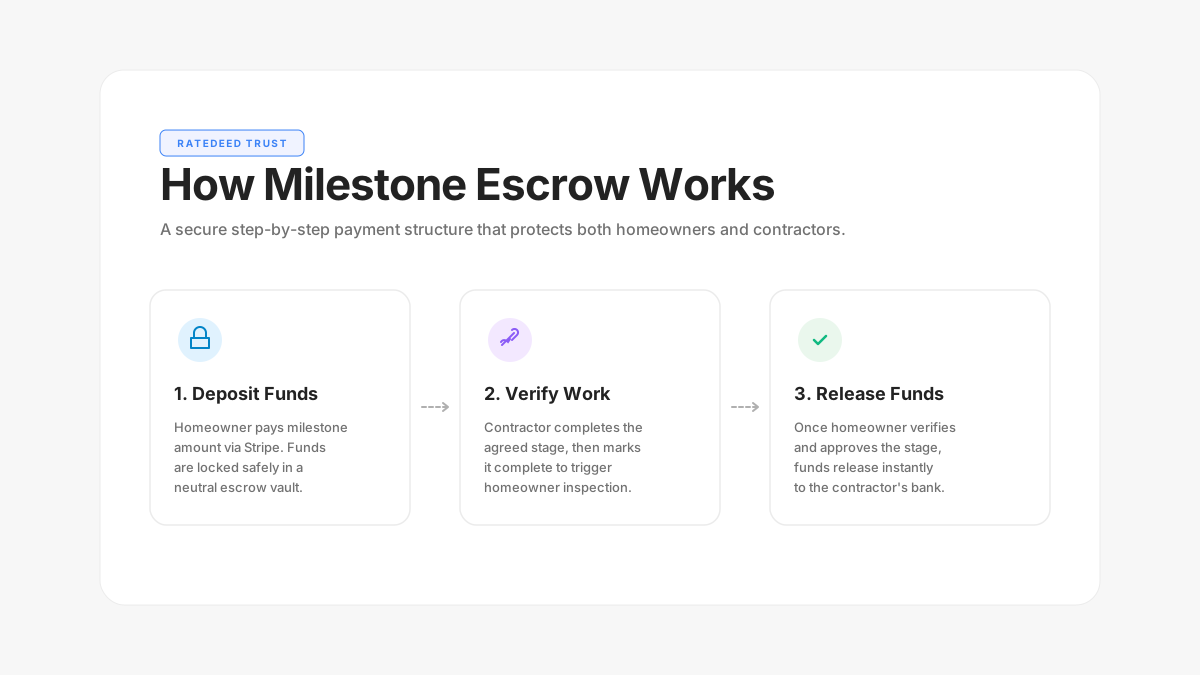
When you pay through Ratedeed, your money goes into escrow — held by a third party (our payments infrastructure, built on Stripe) and released to the contractor only when mutually agreed milestones are met. Neither side can unilaterally take the funds.
Here's exactly how that flow works, step by step.
The basic principle
Money never sits in the contractor's bank account until the work is verified. It sits in escrow, neutral territory, until one of three things happens:
- You confirm the milestone is complete, and funds release automatically
- The contractor marks the milestone complete, you don't dispute within 72 hours, and funds release
- A dispute is opened, and Ratedeed's resolution team reviews the case
Step 1: You accept a quote
When you accept a contractor's quote, no money moves yet. The quote is just an agreement on scope and price. The contractor has been notified you're ready to move forward.
Step 2: You fund the escrow
You pay the agreed amount via Stripe (card or ACH). At this moment, the funds are no longer in your bank account, but they are not yet in the contractor's account. They're held in escrow.
This is the part that protects you: The contractor can see the funds are funded and ready. They know they will be paid. But they cannot withdraw the funds unilaterally — and neither can you reverse them without going through dispute resolution. The money is committed, but conditional.
Step 3: Work begins (funded_in_progress)
Once escrow is funded, the contractor starts the job. The job status moves to "funded_in_progress." Everyone can see this status in the jobs dashboard — homeowner, contractor, and (if needed) Ratedeed support.
Step 4: Milestone completion
For milestone-based jobs (see our milestone flow below), each milestone is verified before its portion of the funds releases. For simple jobs, the whole escrow releases on completion.
There are two paths to release:
Path A — You confirm: The contractor marks the milestone done. You receive a notification. You tap "Approve & Release." Funds move to the contractor's pending payout balance.
Path B — Auto-release (72 hours): The contractor marks the milestone done. If you don't respond within 72 hours (no approval, no dispute), the funds release automatically. This protects contractors from being held hostage by silent homeowners.
Step 5: Payout to contractor
Released funds land in the contractor's Ratedeed payout balance. The contractor requests a payout, and Stripe transfersthem to their linked bank account (typically 1-2 business days).
The dispute path — what happens when it goes wrong
If the milestone isn't actually done, or the quality is wrong, you don't approve. You open a dispute.
- You tap "Raise Dispute" on the job, select the milestone, and describe the issue (photos and notes are encouraged)
- The job status moves to "disputed" — funds are frozen
- The contractor is notified and can respond with their side
- Ratedeed's resolution team reviews both sides, the job history, and any uploaded evidence
- The team can resolve in one of four ways:
- release_all — contractor was right, funds release
- refund_all — homeowner was right, funds return to homeowner
- split — partial work completed, partial refund
- resume — counterparty has a chance to fix the issue; funds remain frozen until re-review
Need a qualified home improvement contractor?
Compare licensed and insured professionals in your local area, check ratings, and request free quotes.
Milestone-based funding — the bigger-job version
For larger jobs (remodels, roof replacements, anything over a few thousand dollars), lump-sum escrow is still risky — what if the contractor disappears mid-project? Milestone funding solves this.
The contractor structures the quote into milestones — for example:
- Demo & rough-in (20% of total)
- Material delivery & install (50%)
- Final inspection & punch list (30%)
You fund the full amount up front (it all sits in escrow), but each milestone releases independently. If milestone 1 doesn't pass, you freeze payments for milestones 2 and 3 without losing the original funding.
What escrow doesn't cover
Be honest about the edges:
- Change orders outside the original scope are not covered. If you and the contractor agree on additional work, that's a new escrow or a separate outside transaction.
- Material quality disputes ("I expected better tile") require evidence. Photos at delivery and install protect both sides.
- Permit failures are between you and the contractor's licensing board. Ratedeed's dispute team can refund based on incomplete work, but we don't adjudicate licensing violations.
What escrow replaces (and what most marketplaces still get wrong)
Most contractor marketplaces do one of two things — both bad:
- Direct payment — homeowner pays contractor outside the platform. No recourse if something fails.
- Upfront 100% to contractor — platform masks the risk until the contractor disappears, then everyone's surprised.
Ratedeed's escrow model is closer to how real estate closings work than how most contractor apps work. The funds are committed, but conditional. Neither party can unilaterally take them.
| Feature | Ice Dams | Attic Condensation |
|---|---|---|
| Root Cause | Heat escaping attic melts snow on roof; meltwater refreezes at cold eaves. | Warm, humid house air leaks into attic and condenses on the cold roof deck. |
| Primary Location | Roof edges, eaves, gutters, and exterior wall top plates. | Underside of the roof decking, rafters, and throughout the attic insulation. |
| Key Visual Signs | Thick ridges of ice along the roofline; huge icicles; water pooling on the roof. | Frost or water droplets on roof decking; black mold/mildew; rusted nails; damp insulation. |
| Best Long-Term Fix | Add attic insulation, seal warm air leaks from the living area, and ensure proper eave/soffit ventilation. | Seal air leaks, ensure exhaust fans vent outside (not into attic), and balance attic ventilation. |
The short version
- You pay into escrow. Money is committed but not released.
- Contractor does the work.
- You approve (or auto-release after 72 hours if you don't respond).
- Funds move to contractor's payout balance.
- If something is wrong, you dispute. Ratedeed freezes and reviews.
That's it. No "trust me" required from either side. The system enforces the trust.
If you're a contractor reading this — you get paid faster and more reliably than chasing checks, and you're protected from homeowners who refuse to pay for completed work. If you're a homeowner — you can hire with confidence knowing the money is conditional on the work happening.
Welcome to Ratedeed.