
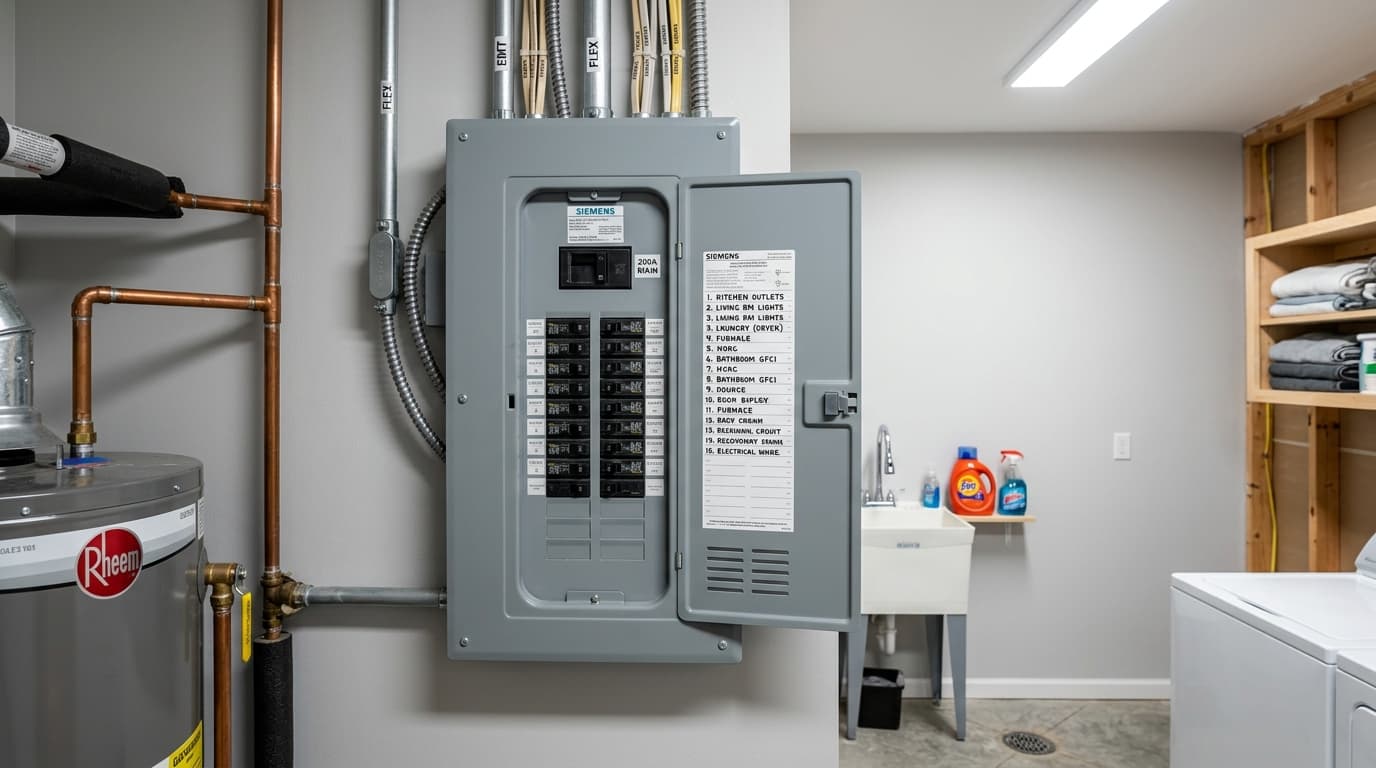
Your electrical panel is the single most important safety device in your home. It divides incoming power into circuits and trips a breaker when something draws too much current, preventing wires from overheating and starting fires.
Yet most homeowners never think about their panel until the lights go out, an outlet scorches, or a home inspector flags it during a sale. By then, you're dealing with an emergency instead of a planned upgrade.
Here are the signs your panel may be overdue for replacement.
1. Your panel is over 30 years old
Panels installed before 1990 were sized for homes with far fewer appliances. A 100-amp panel from 1985 struggles to run a modern kitchen, an EV charger, and two air conditioners at the same time. If your panel's brand is Federal Pacific Electric (FPE) or Zinsco, those brands have documented defect histories and should be replaced regardless of age.
Brand recall history: FPE Stab-Lok panels are estimated to fail to trip up to 25% of the time. Many insurers will not write a policy on a home with one. Get it replaced.
2. Breakers trip frequently
A breaker tripping once in a blue moon is normal. Tripping every time you run the microwave and the toaster on the same circuit is the panel telling you it's overloaded. Don't just reset it — investigate.
3. Lights flicker when appliances kick on
If the lights dim briefly when the AC compressor starts, the panel may be undersized or have a loose connection. Either way, an electrician should look at it.
4. Burning smell or warm panel cover
Turn off the main breaker and call an electrician immediately. A warm panel cover or acrid smell means a connection is overheating. This is a fire hazard, not a "wait and see" situation.
5. You need new high-draw appliances
Adding any of these usually requires a panel upgrade or subpanel:
- EV charger (typically 40-60 amps dedicated)
- Tankless water heater (often 80 amps)
- Hot tub or sauna
- Mini-split HVAC system
- Second kitchen
6. You're using power strips as permanent outlets
Daisy-chained power strips are a symptom of too few circuits, not too few outlets. Each new circuit should come home to a panel that has room for it. If your panel is full of tandem breakers just to fit everything, you've outgrown it.
7. You're selling the home
Buyer inspectors almost always flag old or undersized panels. Replacing it before listing often returns more in sale price and faster closing than it costs.
100 Amp vs. 200 Amp: which do you need?
| Home profile | Recommended panel |
|---|---|
| Under 1,500 sq ft, gas heat, no AC | 100 amps |
| 1,500-2,500 sq ft, central AC, standard appliances | 150 amps |
| 2,500+ sq ft, two AC units, EV charger | 200 amps |
| All-electric home with heat pump + EV | 300-400 amps |
What an upgrade actually includes
A panel upgrade is more than a box swap. A qualified electrician will:
- Pull a permit
- Replace the panel and main breaker
- Inspect and replace the meter base if corroded
- Verify grounding and bonding to your water service
- Test every circuit under load
Need a qualified electrical contractor?
Compare licensed and insured professionals in your local area, check ratings, and request free quotes.
Electrical work is the one trade where DIY is genuinely dangerous. If you recognize any of the signs above, get a licensed electrician to quote the upgrade before it becomes an emergency.