
No hot water is one of the most disruptive, urgent home failures — and one of the most misdiagnosed. Many homeowners call an emergency plumber when the fix is a $20 thermocouple or a flicked breaker, and many others "fix" a simple symptom while a costly leak saturates a wall.
Before you pick up the phone, walk this diagnostic flowchart.
Step 1: Is it really the water heater?
Before anything else, verify the tank itself is the problem:
- Other gas/electric appliances working? Yes → utility service is fine.
- Cold water at every hot tap (not just one)? Yes → it's the heater, not a single faucet cartridge. -Pooling water around the base? Yes → possible leak, jump to Step 5.
Step 2: Identify your water heater type
| Type | Clue |
|---|---|
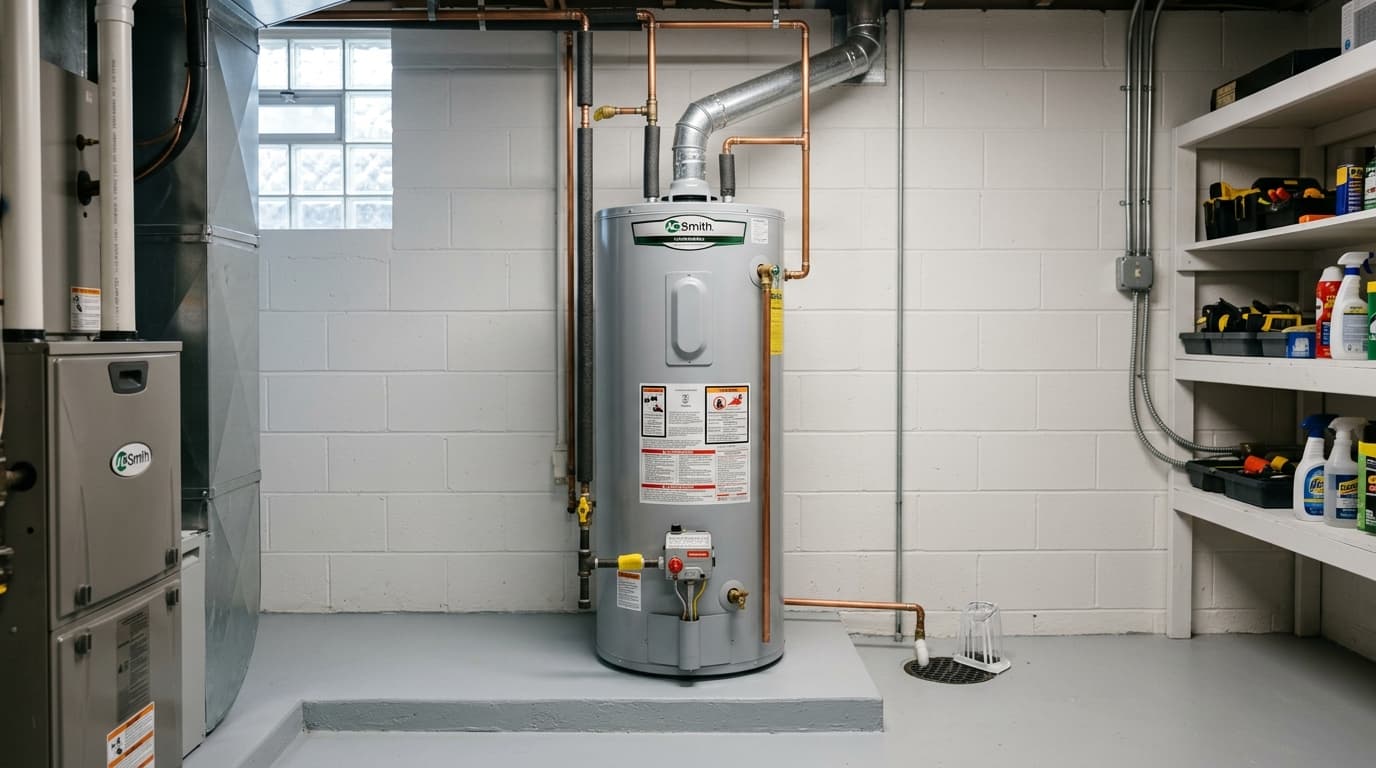
| Gas tank | Exhaust flue on top, gas line + pilot |
| Electric tank | No flue, two access panels on the side |
| Tankless gas | Wall-mounted, gas line in, no flue above |
| Tankless electric | Wall-mounted, large electrical cable in |
Step 3: Match symptom to cause
A. No hot water at all
Gas tank:
- Is the pilot out? If yes, light it (or relight per the unit's instructions). If it won't stay lit, thermocouple is the most common replacement — a $20 part.
- Is the gas valve ON? Check both the knob and the inline valve.
- If you smell gas — shut gas off at the meter, leave the house, call utility. Do not relight.
Electric tank:
- Check the breaker for the water heater — typically a 30-amp double-pole. If tripped, reset once, once. If it trips again, you have a short — usually the lower element.
- Press the red reset button on the upper thermostat. If it clicks and powers on, the high-limit tripped. If it trips again immediately, an element is grounded.
Tankless (gas or electric):
- Check error code on the display. Tankless manufacturers (Rinnai, Navien, Rheem) use standard codes — Rinnai code 11 means ignition failure, code 10 means air supply issue.
- Scale build-up in the heat exchanger is the #1 tankless failure. Annual descaling with vinegar (or a descal kit) prevents most error codes.
Safe DIY stops here: Anything past the thermocouple, the breaker, or the error-code lookup requires a licensed plumber or electrician. Gas valves and 240V elements send homeowners to the ER every year.
B. Hot water runs out quickly
- Cause 1: Lower heating element failed (electric). Top element makes the top hot, lower element keeps it hot. If only the top works, you get 5 minutes of hot then cold.
- Cause 2: Dip tube broken. This tube sends cold to the bottom. If broken, cold mixes at the top and runs out fast. Tip: look for plastic chips in aerators.
- Cause 3: Undersized tank for the household. If your family grew, you grew out of the tank.
C. Water is too hot / not hot enough
- Look for the thermostat dial on the gas valve or behind the electric lower access panel.
- Recommended setting: 120°F. Higher risks scalding; lower invites Legionella.
- If adjustments don't take, the thermostat itself may need replacement ($30-100 part + labor).
D. Rusty or smelly hot water
- Rusty hot water only (cold clean) → anode rod consumed or tank corroding internally.
- Replace the anode rod ($25-50 part) — many tanks are tossed when only the anode died.
- Sulfur / rotten egg smell → bacteria in the anode reacting with sulfate. A magnesium → aluminum anode swap and a hydrogen peroxide flush usually resolves it.
E. Leaking from the tank base
This is the end-of-life failure. Replace, do not repair. A slow leak at the base means the inner tank is corroded. Patching the outer jacket doesn't fix the inner tank, and a slow leak becomes a flood.
Step 4: Age check — should I fix or replace?
| Age | Recommendation |
|---|---|
| 0-6 years | Fix. Likely a cheap part. |
| 7-9 years | Fix if under $300; budget for replacement. |
| 10+ | Replace. Tank is on borrowed time. |
A tank water heater's lifespan is 8-12 years. Past 10, you are risk pooling a leak that costs 5x the replacement to clean up.
Step 5: When to call a plumber
- Gas valve or gas line involved
- 240V electrical work past the breaker
- Tankless internal components (controller, flow sensor, fan motor)
- Anything inside the tank (dip tube replacement)
- Pressure relief valve (TPR) discharge — implies overpressure, serious safety issue
Need a qualified plumbing contractor?
Compare licensed and insured professionals in your local area, check ratings, and request free quotes.
A surprising number of "no hot water" calls are $20 fixes the homeowner can do safely. The rest — especially the gas and 240V ones — are worth paying a licensed plumber $150-300 to do correctly. The judgment call is the actual skill.