
If you are planning a home remodel, kitchen renovation, or roof replacement in California, there is one legal statute every homeowner and contractor must know: California Business and Professions Code § 7159.5(a)(3).
Under California state law, it is a misdemeanor crime for a home improvement contractor to ask for or accept an upfront down payment that exceeds 10% of the total contract price or $1,000, whichever is less.
Yet across Los Angeles, San Diego, San Francisco, and the Central Valley, rogue operators and uninformed contractors routinely demand 30%, 40%, or even 50% upfront before lifting a single tool.
Here is the complete legal breakdown of California's down payment law, the penalties for non-compliance, and how milestone escrow protects both homeowners and honest pros.
The Exact Text of California Business & Professions Code § 7159.5
California has some of the strictest consumer protection standards for residential construction in the nation. The Contractors State License Board (CSLB) explicitly enforces:
"If a down payment will be charged, the downpayment may not exceed one thousand dollars ($1,000) or 10 percent of the contract amount, whichever is less." — Cal. Bus. & Prof. Code § 7159.5(a)(3)
Let’s look at what this means in practice across real project budgets:
- $15,000 Bathroom Remodel: 10% is $1,500. However, because the statutory cap is whichever is less, the legal maximum down payment is $1,000.
- $60,000 Kitchen Renovation: The legal maximum upfront deposit is still strictly $1,000.
- $120,000 Full Home Addition: The legal maximum upfront deposit remains strictly $1,000.
- $5,000 Exterior Paint Job: 10% is $500 (which is less than $1,000). The legal maximum down payment is $500.
If a contractor hands you an estimate for a $40,000 remodel and asks for a $15,000 deposit check to "order materials," they are in direct violation of California statutory law.
Why Does California Have the $1,000 Limit?
The California Legislature established this strict rule because upfront deposit fraud consistently ranks among the top consumer crimes reported to District Attorneys and the CSLB.
When contractors receive tens of thousands of dollars before beginning work, two destructive patterns frequently emerge:
- The Floating Cash Trap: The contractor uses your deposit to pay off past-due lumber bills or payroll from an earlier job that ran over budget.
- Loss of Leverage: Once the contractor has 40% to 50% of your money, their financial urgency evaporates. They delay start dates, show up for two hours once a week, and juggle other jobs while your house sits gutted.
By restricting upfront cash to $1,000, California law ensures that contractors are paid as work progresses, rather than financing their business on consumer risk.
Are There Any Exceptions to the $1,000 Rule?
There is only one rare exception under California law: Joint Control Agreements or Blanket Performance Bonds.
Under Cal. Bus. & Prof. Code § 7159.5(a)(8), a contractor may receive progress payments before work is performed if they have filed a formal blanket performance and payment bond with the CSLB Registrar, or if funds are administered through an approved, independent third-party escrow joint control company.
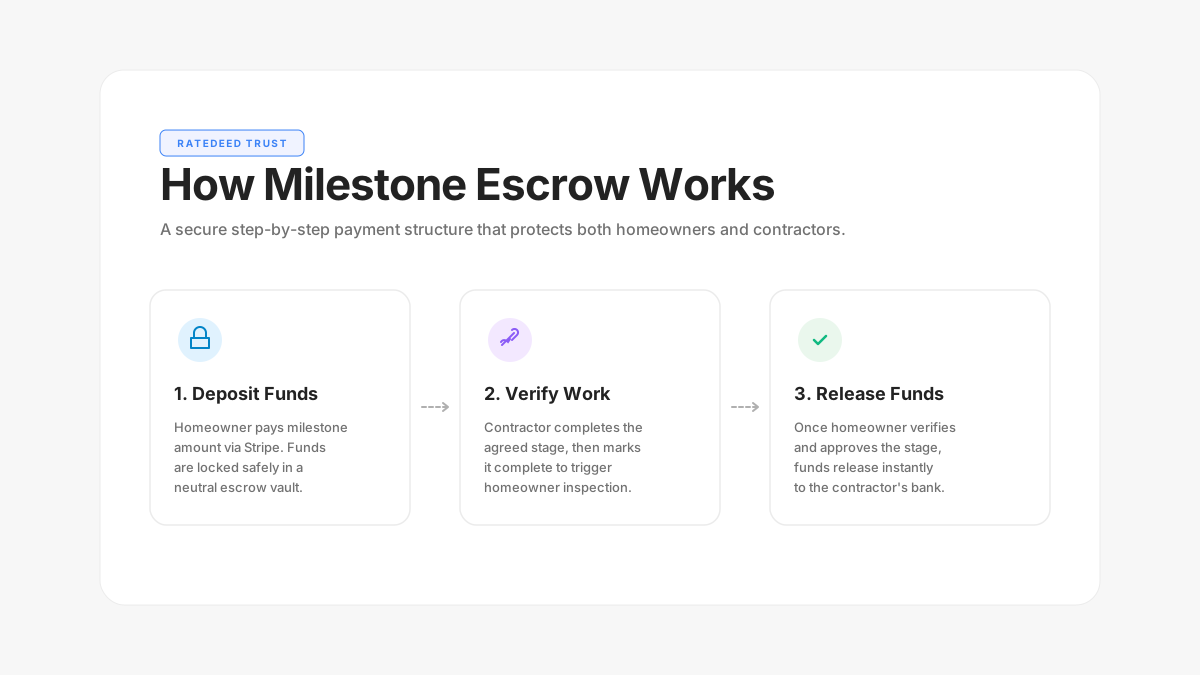
This is precisely why Ratedeed Milestone Escrow is the gold standard for California construction: funds sit safely in escrow, satisfying the contractor that capital is guaranteed, while money is only released after milestones are inspected and approved.
Legal Penalties for Contractors Who Demand Excessive Deposits
Demanding more than $1,000 upfront is not merely a civil contract issue; it is a criminal misdemeanor under California law:
- Criminal Charges: Conviction under § 7159.5 can carry fines ranging from $100 to $5,000 and possible jail time for repeat offenders.
- CSLB Disciplinary Action: The Contractors State License Board can suspend or revoke the contractor's license and order formal restitution to the homeowner.
- Contract Invalidation: Demanding an illegal deposit can render contract clauses unenforceable against the consumer in court.
How to Calculate Your Project's Legal Limit
Before handing over a deposit to any contractor in California, test your numbers using the free Ratedeed Contractor Deposit & Scam Risk Calculator.
Simply enter your project estimate and the contractor's deposit request to see the exact statutory threshold and print a legal compliance report.
The Smart Solution: Milestone-Based Escrow
Honest California contractors need to know they will get paid when work is completed. Homeowners need to know their money is safe until work passes inspection.
With Ratedeed Milestone Escrow:
- The project budget is agreed upon with defined milestones (e.g. 10% Foundation, 30% Framing, 30% Drywall & Mechanical, 30% Final Punchlist).
- The homeowner securely funds the milestone in advance.
- The contractor executes the phase with 100% confidence the money is locked and waiting.
- Funds release immediately upon the homeowner's approval.
Never risk an unearned upfront check. Find verified, escrow-protected contractors on Ratedeed today.